
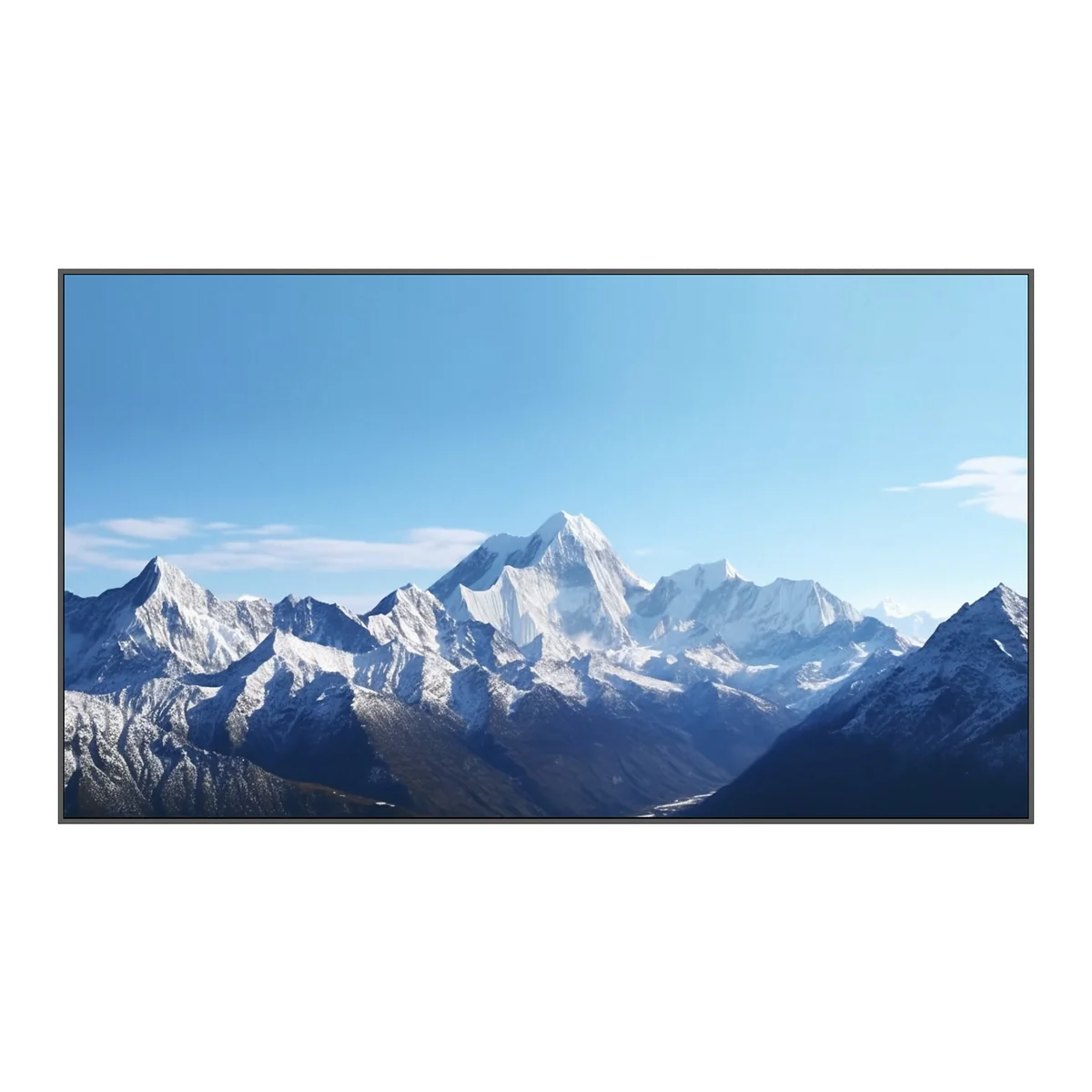
MiniLED buys you contrast and brightness uniformity. If your content is mostly white text on a coloured background, you will not see the benefit.
What MiniLED actually changes
A conventional LCD uses a single backlight behind the whole panel. Brightness is uniform across the screen and determined by one setting, so a bright object and a dark object next to it receive the same backlight.
A MiniLED panel divides the backlight into hundreds or thousands of individually dimmable zones. When the content is dark in one region, those zones are dimmed, which raises the effective contrast and reduces the grey haze that makes dark scenes look washed out.
The LCD layer still modulates the light, so MiniLED is not the same as OLED. What changes is the quality of the illumination behind it.
Where the improvement is visible
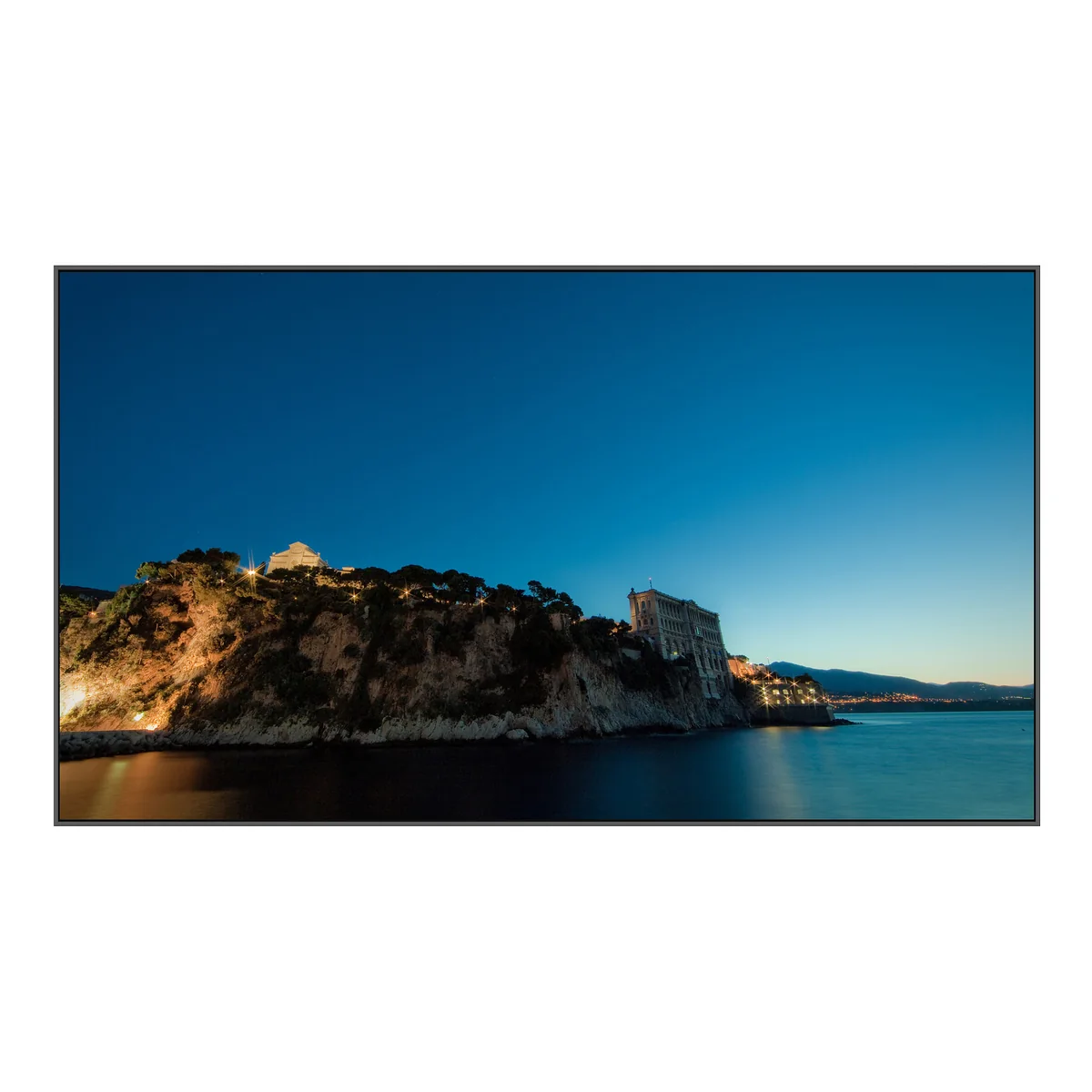
The difference is most obvious with high-contrast content: product photography with a black background, night scenes in video, and any layout that relies on deep blacks to look premium.
It also shows up in very bright rooms. A MiniLED panel with high peak brightness holds a punchy image in daylight better than a standard panel of the same nominal brightness, because the highlights can be driven harder without lifting the whole screen.
Uniformity is the quieter benefit. On a large conventional panel, the corners are often slightly dimmer than the centre. Zoned backlighting can compensate, which matters for video walls where two adjacent panels must match.
Halo, blooming and what to check
Zoned backlighting can produce a soft halo around a very bright object on a black background, because the zones are larger than the bright detail. The effect depends on the zone count and the control algorithm.
Ask to see your own content on the panel rather than a manufacturer demo reel. A demo chosen to flatter the technology will hide halo; a spreadsheet or a white logo on black will reveal it immediately.
지정하기 전에 당사에 문의하십시오.
실행하려는 공간이나 위치, 콘텐츠를 보내주세요. 우리 엔지니어들이 이를 검토한 후 실용적인 권장 사항을 제시해 드릴 것입니다. 평가 비용은 무료입니다.
Brightness, heat and lifetime
Driving a panel to very high peak brightness generates heat, and the thermal design of the enclosure becomes the limiting factor rather than the panel. A 4K MiniLED panel rated at 1800 nits peak will not hold that output in a sealed box in a hot lobby.
Confirm the typical brightness, not only the peak figure, and ask how the display behaves after an hour at full output. Commercial panels that derate gracefully are more useful than ones that shut down.
What it costs and what it replaces
MiniLED sits between a standard commercial LCD and a small-pitch LED wall. It is usually the better answer when the required brightness is in the 1,000 to 2,000 nit range and the panel size is between 43 and 98 inches.
If the requirement is a seamless image over a very large area, MiniLED cannot match an LED wall, because the panel still has a bezel. If the requirement is a high-contrast single screen in a bright space, MiniLED is often cheaper than the LED alternative.
When standard LCD is the right answer
Standard commercial LCD remains the sensible choice for menus, schedules, wayfinding, information boards and any content dominated by flat colour and text. In those applications the extra contrast is invisible and the money is better spent on a brighter panel or a better enclosure.
A practical test is to look at your own content and ask how much of it is genuinely dark. If the answer is less than about a third, MiniLED is unlikely to pay for itself.
Our MiniLED digital signage range lists the contrast, brightness and zone specifications for each size so you can compare against the standard models in the same catalogue.
Specifying with confidence
Ask for the typical and peak brightness, the number of dimming zones, the contrast ratio measured with local dimming active, and the panel life at the brightness you intend to run. Ask to see your content, and ask what happens at the end of the warranty.
With those four answers you can compare two suppliers fairly. If you would like us to review a specification or a competing quotation, our engineers will go through it with you line by line.
구매자가 우리에게 묻는 질문
우리 엔지니어들이 이 주제에 대해 가장 자주 답변하는 질문은 다음과 같습니다. 당신의 것이 여기에 없다면, 우리에게 보내주세요 그러면 우리가 직접 답변해 드리겠습니다.
Is MiniLED the same as OLED?
No. MiniLED is a backlight technology used behind an LCD layer, with the backlight divided into many dimmable zones. OLED emits light per pixel. MiniLED is generally more economical at large commercial sizes and does not suffer from image retention.
How many dimming zones do we need?
More zones mean finer control and less halo, but the control algorithm matters as much as the count. Ask to see your own content on the panel rather than a demo video, and judge the result with your eyes.
Will MiniLED be bright enough for a shop window?
MiniLED helps because the highlights can be driven harder without lifting the whole image, but a window facing daylight is still a brightness problem first. Check the typical brightness figure and consider a high-brightness model.
Does MiniLED cost more to run?
Not necessarily. Zoned dimming reduces backlight power on dark content, so a MiniLED panel showing a dark layout can consume less than a conventional panel showing the same image at the same apparent brightness.
Want a specification review?
Send us your content and the ambient light conditions. We will tell you whether MiniLED is worth specifying or whether a standard panel will do the job.